Showing posts with label C. S. Lewis. Show all posts

Sunday, May 6, 2018

Ten Children's Books Grown-ups Should Read


"A children's story that can only be enjoyed by children 
is noa good children's story in the slightest." 
 -- C. S. Lewis


The books we read as children stay with us for a lifetime, but we don't have to quit reading children's books just because now we wear long pants and have adult cards at the library. In fact, children's books are for everybody. All of us have a child inside — a child that wants to play and laugh and learn.  


Here are ten books that will delight and nourish the child within.


The Wind in the Willows, by Kenneth Grahame

It's springtime, and Mole is doing his spring cleaning. But sun and blossoms in the breeze call him to explore the great outdoors. In time, he meets new friends  Rat, Toad, and Badger. They are always ready for a roadtrip, whether on foot or by boat or carriage or motorcar. They have many whimsical adventures on the river and in the woods. Want to feel inspired to follow your own heart's dreams? This is the book.


The Little Prince, by Antoine de Saint-Exupery

"Please. . .draw me a sheep. . ." You don't expect to hear a voice when your plane has crash-landed in the Sahara. You don't expect to meet a child. And if you do, you certainly don't expect to be asked to draw him a sheep. But if you listen to his story, you will learn to love the child and to love the stars and to love this book. 


Beatrix Potter: The Complete Tales, by Beatrix Potter

Peter Rabbbit, Squirrel Nutkin, Jemima Puddleduck, Mrs. Tiggy-Winkle  — these animal characters are bursting with very human personality traits. They all have serious problems to solve, villains to outwit, journeys to take — the very stuff of stories.


Hans Christian Andersen, The Complete Fairy Tales and Stories, translated [into English] by Erik Christian Haaugard 

The Ugly Duckling. The Emperor's New Clothes. The Little Mermaid. . . .so many wonderful stories compiled and shaped by a master teller of tales. This is my favorite translation of Andersen's fairy tales.


Alice's Adventures in Wonderland, by Lewis Carroll

A rabbit hole, a Mad Hatter, a hookah-smoking caterpillar. . .colorful iconic characters, sophisticated humor and word play,  and inspired nonsense  it's all here in mathematician Lewis Carroll's whimsical masterpiece. It's brillig!


The Chronicles of Narnia, by C. S. Lewis

Four English children, siblings, are evacuated to the country to escape World War II. But it seems they can't escape war after all, for they stumble into another world where they meet a lordly Lion who asks them to lead a fierce battle.  In these stories, we come to know the Lion in that world, so that we can know Him better in this world.


The Book of God for Children, by Walter Wangerin Jr.

This is a great Bible-story book to share with your children and grandchildren. And it's a good overview of the whole Bible story from Creation to Apocalypse.


Little Women, by Louisa May Alcott

This charming classic story, set in Civil War era New England, chronicles the journey of four sisters from childhood into womanhood — their friendships, loves, and life lessons.


Aesop's Fables, by Aesop

These short stories with animal characters are simple enough for children to understand and profound enough to leave a lasting impression on adults. They are an important part of our world cultural heritage.


Bridge to Terabithia, by Katherine Paterson 


If Katherine Paterson published her grocery lists and dry cleaning receipts, I would want to read the book  she's that good of a writer. This book is fantastic, and I'm also using it to represent all the Newbery winners, such as Madeleine L'Engle, Kate diCamillo, E. L. Konigsburg — the cream of the crop of amazing children's writers. 

If you're looking for a good children's book, you can always  check the list of Newbery winners published by the American Library Association: Newbery Winners.


What was I thinking? Ten children's stories grown-ups should read? TEN? 

Actually, there are hundreds — maybe thousands — but perhaps these few will suggest the wealth of children's stories that adults can enjoy equally and appreciate more. 

Please. . .leave a comment and tell me one of your recommendations!

Image credits:
    Children reading -- Photo of painting -- The First Bible Lesson 
         -- Public Domain in the United States

Monday, April 16, 2018

Surprised by Joy

The world of writer and Christian apologist C. S. Lewis (Jack) was decidedly masculine.

The Kilns

Jack lived in a house called the Kilns, in a quiet, predictable life with his brother Warren Hamilton Lewis (Warnie).

Magdalen College, Cambridge

He was a professor at an all-male school.  

He had a group of good friends – all men. They met at a local pub for drinks and intellectual discussions. He went on walking trips with Barfield, Tolkien, or Warnie   all men.

Jack's world was pretty much limited to men — tweed jackets, foaming pints, and pipe smoke.


And then came Joy.

Helen Joy Davidman

A child prodigy raised in the Bronx, Helen Joy Davidman read the writings of George MacDonald. She later wrote that these stories “developed in me a lifelong taste for fantasy, which led me years later to C. S. Lewis, who in turn led me to religion.” She went on to earn a Master’s degree in English literature from Columbia. She was an award-winning poet and the author of two novels.

In youth, she was an atheist and a Communist. Her marriage to William Lindsey Graham was unhappy. Her husband drank too much and was given to outbursts of temper. 

Partly because of the writings of C. S. Lewis, Joy converted to Christianity. She struck up a trans-Atlantic correspondence with Jack and actually fell in love with him long distance, although her affections were not reciprocated. She even made a trip to England with her two sons.

The Study at the Kilns
One day, Lewis had a letter from Joy, asking if they could meet at a restaurant. When the day came, Joy found Jack and Warnie at a table, and a lively conversation instantly ignited. 

Warnie later confided to his diary that Jack and Joy had built “a rapid friendship.” He described Joy as “a Christian convert of Jewish race, medium height, good figure, horn rimmed specs, quite extraordinarily uninhibited.” And he later wrote, “For Jack the attraction was at first undoubtedly intellectual. Joy was the only woman whom he had met…who had a brain which matched his own in suppleness, in width of interest, and in analytical grasp, and above all in humour and a sense of fun.” 

Joy and the two boys spent a couple of weeks as guests of Jack and Warnie at the Kilns. While in England, Joy received a letter from her husband saying that he was having an affair with her cousin and he wanted a divorce. She went home to try to save her marriage.

After the divorce, Joy returned to England, found an apartment, and set the boys up in school. But child support from Gresham soon stopped, and she found herself in financial straights. Lewis found her a house close to the Kilns and also paid for the boys’ schooling.

Jack and Joy helped each other with their writing, with Joy serving as the inspiration for Orual in Jack’s Till We Have Faces.

Suddenly Joy had another problem, when her Visitor’s Visa was not renewed by the Home Office. Lewis, wanting to help a friend, offered to marry Joy in a civil ceremony to keep her from being sent back to America. This was a marriage in name only  they continued to live separately.

One day Joy tripped on a phone wire and broke her leg. In the hospital, the doctors found that Joy had a far more serious problem  breast cancer that had spread to her bones. Their prognosis? Incurable.

Upon receiving this news, Jack was devastated, for he now realized that he loved Joy as she loved him.  

Joy underwent several operations and procedures to treat the cancer. In March, Warnie wrote in his diary: “One of the most painful days of my life. Sentence of death has been passed on Joy, and the end is only a matter of time.”  

Jack and Helen were married in a religious ceremony at the hospital on the 21st of March in 1957. After that, several of Jack’s old friends avoided them, because Joy had been divorced.

Lewis's bedroom at the Kilns

A week later, Joy went home to the Kilns — and there she enjoyed a long remission of the cancer. They took a few trips.
But the cancer returned, and she died in July of 1960.

Lewis had written a poem as a tribute for his friend, Charles Williams, and he adapted it for Joy:

Here the whole world (stars, water, air,
And field, and forest, as they were
Reflected in a single mind)
Like cast off clothes was left behind
In ashes, yet with hopes that she,
Re-born from holy poverty,
In lenten lands, hereafter may 
Resume them on her Easter Day.  


Jack had written a memoir of his early life, entitled Surprised by Joy. By joy, he meant a longing for something so other, so holy, so awesome, that there are no words to describe it. God must have chuckled when He sent Joy — as a person — into Jack's life

Their time together was short but certainly transformative for both of them.

On April 18th, we celebrate the birthday of Helen Joy Davidman Lewis, while Jack and Joy celebrate in Heaven.

Image Credits:
    The Kilns -- Author: jschroe from Kailua-Kona, Hawaii, USA;
    Magdalen College -- source unknown;
    Eagle and Child sign -- Author: ceridwen
   Joy Davidman -- Wikipedia, Author: The Book Haven, Cynthia Haven's blog 
         -- used for illustration and identification;
    Lewis's study at the Kilns -- Author: jschroe from Kailua-Kona, Hawaii, USA;
    The Kilns, Jack's bedroom -- Author: jschroe from Kailua-Kona, Hawaii, USA;
    River and woodland -- Author: inkknife_2000

Sunday, November 29, 2015

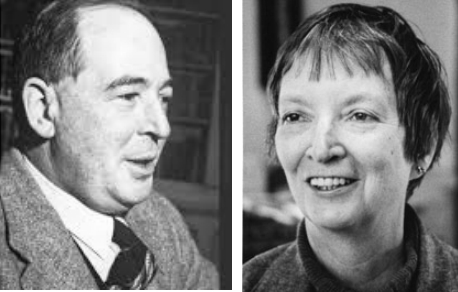
Happy Birthday, C. S. Lewis and Madeleine L'Engle!

Sometimes, in a smaller library, I find these two "L" authors next to each other on the shelf: C. S. Lewis and Madeleine L'Engle. That tickles me because they are two of my favorite writers of all time.


  • But these two share more than shelf space. A birthday, for one. Both were born on November 29th -- Lewis in 1898 and L'Engle in 1918. And they share other similarities as well.
  • Both developed a love of books and reading early in life.
  • Neither one did very well in the early years of school. Madeleine's teachers often thought her dull-witted. She sometimes had trouble fitting in at the boarding schools where her parents sent her. Lewis was sometimes bullied in grade school, scarring him with terrible memories.
  • They shared a common faith. Both were Christians--and Anglican (Lewis) /  Episcopalian (L'Engle).


Madeleine as librarian at the library of St. John's Cathedral,
now known as the Madeleine L'Engle Library

  • They share celebrity and popularity. Madeleine's A Wrinkle in Time has sold more than 14,000,000 copies and counting. Jack's The Chronicles of Narnia (seven books), more than 100 million copies in 47 languages. And these titles represent only a fraction of their prolific output. Both were popular speakers as well as authors.


  • They also share some genres. Both wrote fantasy about space travel and both wrote poetry and nonfiction reflections on life and faith. Both wrote about pain and grief. Both were heavily influenced by the writings of George McDonald.

George MacDonald and his fantasy work, Phantastes

  • Both Lewis and L'Engle had keen and penetrating minds. I would dearly love to hear the two of them in a debate. Wits would clash like swords and words would fly like sparks! 
Magnum Photos
C. S. Lewis was a British academic, a novelist, and a lay theologian. Starting in his teen years, he was entranced by "Northerness" and the Icelandic sagas. He also grew to love nature and taking long walks through the English countryside. Although a confirmed atheist in his youth, his later discussions with Hugo Dyson and J. R. R. Tolkien helped to persuade him to become a Christian and started him down the road to becoming the foremost Christian apologist of the twentieth century.


Publicity photo
for Square Fish Books
Madeleine L'Engle was an American writer, best known for her young adult works -- the Chronos books (the fantasy A Wrinkle in Time and other books in the Time Quintet) and the Kairos Books (the more realistic O'Keefe and Austin family stories). Ironically, some readers found her books "too religious," while some Christian bookstores refused to carry her books because of her controversial views. I had the privilege of hearing Madeleine L'Engle speak many times, and I always noticed that during question and answer sessions, people seemed to look to her to answer the hard questions, to explain the meaning of pain and suffering.

What a joy that today we celebrate two amazing writers who left a great body of meaningful work. One blog post is far too short a space to tell of their accomplishments and of the impact they have made on my life and on so many others.


Photo by Joey Gannon
Thank you, Jack and Madeleine, for being true to your callings, for telling your stories, for wrestling with hard questions. Happy, happy birthday to you both!

Sunday, October 21, 2012

Good Writers, Great Writers


Leo Tolstoy
Good writers have it. 

Style. Elegance. Pzazz. Wit. Charm. The well-turned phrase.  An ear for language. An eye for detail. Punch. Verbal charisma.

Great writers may have it (see above) —or not. 

They may pen lyrical passages and then lapse into writing that is plodding, verbose, or second rate. But you probably won’t mind. You may not even notice. 


Herman Melville
Because for a great writer, it’s not so much about the writing. And it’s not about perfection. It’s about telling a great story.

I guess that’s why Melville can get away with several mind-numbing chapters about the history of whaling in Moby Dick. Or why Tolstoy can use enough character names to fill a phonebook. Or why Ayn Rand can insert a long political rant near the end of Atlas Shrugged.

Randy Ingermanson said that writers don’t sell books because they have no weaknesses. Books sell because of their strengths.


C. S. Lewis
I remember sunning by the pool years ago, reading Perelandra, by C. S. Lewis. I was in the part where the hero Ransom is floating on the golden sea of the planet Perelandra. And floating and floating and still floating. Up and down, up and down. I was getting bored and a little sea sick. 

I thought to myself, "Good grief, I can write better than this!"


J. K. Rowling
And then I laughed, because yes, I did realize the absurdity of that thought. First, because I can't actually "write better than that." And second--and more important, because Lewis is for me, a great writer. When I finish one of his stories, I am a different person. He has given me a glimpse of heaven or hell or of my own secret heart.

I should be so lucky as to "write better than this." Or even to come close.


Ernest Hemingway
A good writer may tickle your intellect. A great writer will touch your heart. 

A good writer will entertain you. A great writer will change you. 

A good writer will probably impress you with her virtuoso performance. 

A great writer isn't a show-off. He is a humble servant to the story he is telling.

Ernest Hemingway, Lewis Carroll, J. K. Rowling, John Steinbeck, Stieg Larsson, John Grisham, Kate di Camillo, Suzanne Collins, Stephanie Plum -- all are widely acknowledged as good writers. Which ones are not only good but great? 


Suzanne Collins
And who decides? Not your high school English teacher. Not your minister. Or your mother-in-law or your analyst or your BFF. Not the New York Times or Publishers' Weekly. It's your call. And mine. We choose. 

Or it might be more accurate to say that great stories choose us. They are speaking words of wisdom and enlightenment. They are calling us to come up higher. We just have to listen and respond.

"Reading good books ruins you for enjoying bad books."
        --The Guernsey Literary and Potato Peel Pie Society,
                Mary Ann Shaffer and Annie Barrows


Saturday, February 11, 2012

Cupid and Psyche


Psyche, by William
Adolphe Bouguereau
Through a prism of tears, the girl watched her parents walk away, leaving her chained to the side of the mountain. 

Her name was Psyche. All men praised her beauty, but no man wanted to marry her, for Psyche was cursed. In desperation, her parents had consulted an oracle, who declared that Psyche was too beautiful for mortal man. They must take her to the mountain, said the seer, and abandon her to the gods.


Leaves scattered and Psyche's hair whipped her face as the West Wind approached. The wind carried the girl away to a beautiful palace to become, at long last, a bride.

Cupid falls in love with Psyche.


But whose bride? 


At night, Psyche lay with her new husband, always in the dark. She never saw his face. And when the first rays of morning came, he was gone.

For her husband had made a law. She must never bring a light to the room where they met. She must never see his face. Her husband wanted to reveal himself in his own time, in his own way.

Psyche soon discovered that she was going to have a child, and somehow this news made her happy and sad all at once.

For Psyche was lonely. She missed her family. And so her husband allowed Psyche’s sisters to visit her in the palace for just one day, but he warned her not to listen to their advice. 


The sisters were overjoyed to see Psyche again, but they warned her that she was in great danger. What kind of a husband hides from his bride? She must discover the true identify of her husband at any cost. They told her that he was a hideous serpent who would devour Psyche and her unborn child.

Later that night, after her sisters had gone, Psyche crept into her bower with a lamp and a knife. She could stand the suspense no more. During the night she lit the lamp and looked on the face of the monster she had married. But instead of a serpent, she saw the handsome Cupid, and she fell deeply in love with him. She bent over to kiss him, but just then a drop of hot oil fell from her lamp onto his beautiful face.


It was the first time she had seen him, and now it would surely be the last time as well. She would never forget the look in his eyes—a look of bitter disappointment and betrayal. Then the light went out and he flew away.

Psyche Opening the Door
 into Cupid's Garden
by John William Waterhouse
How ironic that Cupid, the god whose arrows cause men and women to fall in love with each other, was so "unlucky in love." Or perhaps it was a kind of poetic payback! There’s more to the story, and Cupid and Psyche will go through much grief and torment before they are reunited. But if you really want to experience this myth. . . .

Orual, the heroine of C. S. Lewis’s novel, Till We Have Faces, is Psyche’s sister. She is jealous of Psyche, but she also loves her and truly wants to save her from the “monster” she has married. The story of Cupid and Psyche is retold brilliantly in this masterwork of mythic fiction. 


In Till We Have Faces, Lewis likens the relationship between Cupid and Psyche to our relationship with an invisible God. Do we dare trust this God who hides Himself? The problem, according to Lewis, is not that God is faceless, but that we are. As Orual says about the gods, "How can they meet us face to face till we have faces?"  In this story, we can begin to understand, along with Psyche's sister, what love is and who we truly are.


Happy Valentine's Day from the Stark Raving Mythopath.