Sunday, October 28, 2012

The Story of Babar

I remember reading The Story of Babar, by French author Jean de Brunhoff, as a young child. The cover was bright red and showed an elephant tipping his bowler hat. I suppose you either like elephants in bowler hats or you don't, but I could tell right away that this would be a good book.

Babar is a baby elephant, and his life in the jungle is idyllic. His mother rocks him to sleep in a hammock. He plays with all the other little elephants, building sand castles, tossing balls, and using his trunk for a water pistol. It looks like so much fun.


But then tragedy strikes. Babar is riding on his mother's back, when "an evil hunter" appears and fires his gun. The next picture shows young Babar standing over his dead mother. How could this happen?

I knew a little about death. At my church, a girl just about my age had been hit by a car, and my parents took me to the funeral home, where she was laid out in a small coffin with a beautiful doll. Both the doll and the girl had pink cheeks and dark hair. It was so mysterious and sad...but back to the story.

The hunter tries to catch Babar, but he runs away to a nearby town where he meets a very nice "old lady." She gives him money to buy a suit of clothes and invites him to live with her. She even gives him her sporty red car. When his cousins Arthur and Celeste come for a visit, he takes them to a pastry shop for a treat.

Meanwhile, back in the jungle, the King of the Elephants eats a bad mushroom and dies. In the picture, he looks very sickly and green. Eventually, Babar returns to the jungle and becomes the new king.


The plot and the pictures in The Story of Babar are charming and whimsical and delightful. But this children's writer did not tip-toe around the reality of death. Try as you may, you can't ignore the fact that there are two dead elephants in this book.


The death of Babar's mother is very sad--but as often happens in real life, Babar doesn't have time to stop and feel sorry for himself. He has to run for his own life.

Babar has to move past this horrible experience in order to first survive and then thrive. Though there are terrible things in this world (like evil hunters), there are also wonderful gifts, like the friendship of the old lady. In fact, it was tragedy that propelled Babar to his destiny--to go to the town and meet his benefactor and to gain wisdom and experience.


The death of the elephant king is also sad, and yet, once again, life must triumph. There will be a new king, and that king is Babar.

What we learn from Babar is that even when something terrible happens, we need to keep turning the pages. There is more of the story to come.


Jean de Brunhoff
Jean de Brunhoff was a French writer and illustrator. The Story of Babar began as a bedtime story his wife Cecille told their sons. The sons liked the story so much that they asked their father to illustrate it. Jean de Brunhoff created seven Babar books in all, and later, his oldest son, Laurent, followed in his father's footsteps and created more of the stories. 

Today, Babar is king of a media empire. He has starred in movies and an animated television series. He even inspired a musical composition by that whimsical French composer, Francis Poulenc. 

Children's writers nowadays are cautioned NOT to write about animals that talk and act like people. Brunhoff would have a tough time finding a publisher for Babar in the 21st century. We can only hope that writers and artists will blissfully ignore all these pompous, pain-in-the-rump "rules" of writing and continue to produce wonderful works of whimsy and lyrical beauty.


Sunday, October 21, 2012

Good Writers, Great Writers


Leo Tolstoy
Good writers have it. 

Style. Elegance. Pzazz. Wit. Charm. The well-turned phrase.  An ear for language. An eye for detail. Punch. Verbal charisma.

Great writers may have it (see above) —or not. 

They may pen lyrical passages and then lapse into writing that is plodding, verbose, or second rate. But you probably won’t mind. You may not even notice. 


Herman Melville
Because for a great writer, it’s not so much about the writing. And it’s not about perfection. It’s about telling a great story.

I guess that’s why Melville can get away with several mind-numbing chapters about the history of whaling in Moby Dick. Or why Tolstoy can use enough character names to fill a phonebook. Or why Ayn Rand can insert a long political rant near the end of Atlas Shrugged.

Randy Ingermanson said that writers don’t sell books because they have no weaknesses. Books sell because of their strengths.


C. S. Lewis
I remember sunning by the pool years ago, reading Perelandra, by C. S. Lewis. I was in the part where the hero Ransom is floating on the golden sea of the planet Perelandra. And floating and floating and still floating. Up and down, up and down. I was getting bored and a little sea sick. 

I thought to myself, "Good grief, I can write better than this!"


J. K. Rowling
And then I laughed, because yes, I did realize the absurdity of that thought. First, because I can't actually "write better than that." And second--and more important, because Lewis is for me, a great writer. When I finish one of his stories, I am a different person. He has given me a glimpse of heaven or hell or of my own secret heart.

I should be so lucky as to "write better than this." Or even to come close.


Ernest Hemingway
A good writer may tickle your intellect. A great writer will touch your heart. 

A good writer will entertain you. A great writer will change you. 

A good writer will probably impress you with her virtuoso performance. 

A great writer isn't a show-off. He is a humble servant to the story he is telling.

Ernest Hemingway, Lewis Carroll, J. K. Rowling, John Steinbeck, Stieg Larsson, John Grisham, Kate di Camillo, Suzanne Collins, Stephanie Plum -- all are widely acknowledged as good writers. Which ones are not only good but great? 


Suzanne Collins
And who decides? Not your high school English teacher. Not your minister. Or your mother-in-law or your analyst or your BFF. Not the New York Times or Publishers' Weekly. It's your call. And mine. We choose. 

Or it might be more accurate to say that great stories choose us. They are speaking words of wisdom and enlightenment. They are calling us to come up higher. We just have to listen and respond.

"Reading good books ruins you for enjoying bad books."
        --The Guernsey Literary and Potato Peel Pie Society,
                Mary Ann Shaffer and Annie Barrows


Saturday, October 13, 2012

Happy Birthday, Oscar Wilde


The Irish writer Oscar Wilde is best known for his plays, like "The Importance of Being Earnest," and his novel, The Picture of Dorian Gray.

But to me, he is cherished as the author of some of the most beautiful fairy tales to grace the English language, including The Selfish Giant and The Happy Prince.


High above the city, on a tall pedestal, stood a statue known as "The Happy Prince." The statue was covered with gold. It had sapphires for eyes and a ruby in the hilt of its sword. The statue had been raised in commemoration of a prince who had lived a happy life but was now dead.

A swallow, en route to sunny Egypt for the winter, befriended the Happy Prince. The prince confided in his new friend that he had lived his life in isolation and luxury, without a thought to the hardships endured by his subjects, but now that he was standing in the center of town, he could see how the poor people suffered.


Although the swallow was determined to leave for Egypt, the Happy Prince persuaded the bird to pluck the ruby from his sword and carry it to a poor woman with a sick son. The nights were growing cold, and yet the swallow felt strangely warmed by helping the woman.

Night after night, the prince pleaded with the swallow to carry his treasures to help the poor--even plucking out his sapphire eyes and stripping off his gold plating. Many hungry children were fed because of the generosity of the prince.


At last, the cold grew too severe, and the swallow lay dead at the feet of the prince. The statue--no longer beautiful--was torn down and melted for scrap, but the metal proved to be unusable. Both the metal and the dead bird were thrown in a trash heap.

God looked down on the city of the prince. He asked an angel to bring him the two most precious things in the city. The angel flew all over the city and returned with the dead swallow and the melted statue.

"You have rightly chosen," said God, "for this little bird shall sing forever in my Garden of Paradise, and in my city of gold the Happy Prince shall praise me."


Happy birthday to one of my favorite authors, Oscar Wilde, born October 16, 1854. Unlike the Happy Prince, Wilde's life was short and often very sad. After serving a prison sentence, he died destitute at the age of 46. But much like the prince, he has continued to touch hearts long after his passing, through the lasting legacy of his stories.


A Statue of Oscar Wilde


Saturday, October 6, 2012

The Lowest Form of Wit?


  • Did you hear about the guy who got a job as a baker because he kneaded the dough? ("Needed the dough"—get it? Snort, snort!)    
  • Why are fish so smart? They swim in schools! (Seriously, folks. I kill myself!)

These are the kind of jokes your children or grandchildren will tell you over and over, laughing with joyful abandon at their own cleverness. 

Jokes like these probably gave rise to the popular notion that “A pun is the lowest form of wit.” For too many years, English teachers have taught this heresy, falsely attributed to an assortment of famous writers, as an axiom.


I disagree. (And why are you not surprised?)


The fancy-pants name for a pun is paronomasia, a big word that by its utter pomposity, confers a bit of dignity on the oft-maligned pun. But either way, it means “a play on words"--an intentional confusion between two words that sound alike or between two meanings of a word. 

Puns go way back to the ancient Egyptians, Mayans, Chinese, and Hebrews--and continue right on up to some of the most recent languages on Planet Earth--computer languages. 

Even math geeks have puns.

  • There are 10 kinds of people in the world: those who understand binary, and those who don't.
  • Old math teachers never die. They just become irrational.
  • The ratio of an igloo’s circumference to its diameter = Eskimo Pi

Sure, some puns make us groan, but some are really clever, amusing, literary, or even inspirational. Some of the coolest ones are in the Old Testament, but it's easy to skip right over them, because we don’t know the original language.

Adam’s name was a pun. In Hebrew, adam is the word for man, and adamah is the name for the ground. Remember the story of how God made Adam from the dust of the earth? The story is remembered in his name.

There’s an English language pun that goes like this: 
  • Need to build an ark? I Noah guy. (I know a guy. . .) 


But Noah’s name was also a pun in Hebrew, because his name sounds like the word for “comfort,” and his father Lamech said, “This kid will comfort us in the painful labors caused by the cursed ground.” So every time they called little Noah to dinner, they were reminding themselves that God would comfort them.

The Bible is full of names like this. Babel sounds like the Hebrew for “confused.” Isaac means “he laughs”; Jacob means “he grasps the heel.” And if you know the stories,  you will get the puns. 

Shakespeare was so fond of puns that Samuel Johnson complained about the Bard's penchant for punning in his "Preface to Shakespeare."

In Hamlet, Prince of Denmark, Hamlet refers to his step-father Claudius as “A little more than kin, and less than kind.” What a great play on words—especially if you look at “kind” as a shortened form of “kindred.”

In Romeo and Juliet, when Mercutio tries to persuade Romeo to attend a ball, Romeo replies, "Not I, believe me. You have dancing shoes With nimble soles; I have a soul of lead So stakes me to the ground I cannot move." The pun is sole (of a shoe) and soul (the essence of a person). But the effect is lyrical and melancholy.

Comedian Fred Allen said, "Hanging is too good for a man who makes puns; he should be drawn and quoted."

Sometimes we just get too grown-up, stuffy, and literary to appreciate the joy of puns.


  • Two silk worms had a race, but ended up in a tie.
  • Some cannibals ate a missionary and got a taste of religion.

The lowest form of wit? It seems to me that the lowest form of humor is humor designed to hurt somebody, to make the speaker feel superior to the target. 

And as for puns--hey, if they're good enough for Shakespeare and the Bible, they're good enough for me. And in the right context, they can be funny or thought-provoking. Maybe, like blowing bubbles, they are one of those childhood pleasures we should never outgrow.

Saturday, September 29, 2012

Don Quixote Rides Again!

Alonso Quijano, much like yours truly, is a stark raving mythopath. He reads so many chivalric novels, that he begins to lose touch with reality. At least, that's the way his family sees it. 

Alonso goes so far as to set out on a quest, under the rather marvelous name of Don Quixote de la Mancha. (Marketing is everything.) Every knight needs a squire, and Quixote recruits an affable farmer, Sancho Panza, to ride with him to doom or glory--and doom seems the more likely of the two.


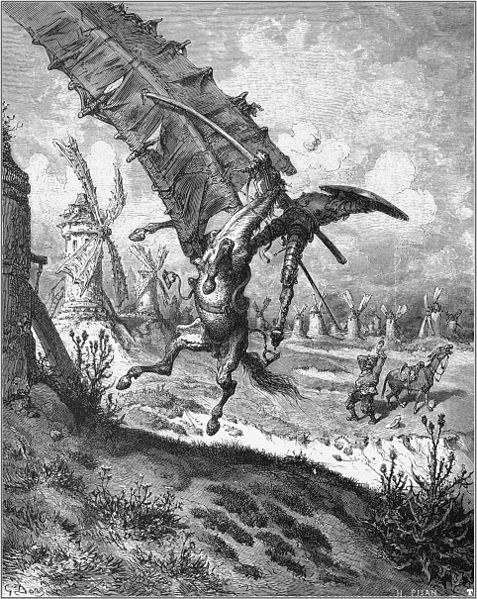
Along the way, this knight wages war on fierce giants (who are actually windmills) and fights to defend the virtue of his beloved Lady Dulcinea (who is actually Aldonza, a woman of ill repute). But who has the clearer vision--Quixote's family, who perform cruel acts to try to "save" him, or Quixote himself, who works hard to see the best in everybody?


Title page, Fourth edition

The two books about Don Quixote's adventures were written by Miguel de Cervantes in early 17th century Spain, and they are considered to be among the greatest literary works of all time. The story has been retold in many forms, but my favorite is the 1964 musical, Man of La Mancha (Music: Mitch Leigh; Lyrics: Joe Darion; Book: Dale Wasserman).

The musical has so many great moments. I love it when Quixote dons a barber's basin and calls it the Golden Helmet of Mambrino. I love it when his family sings "I'm Only Thinking of Him," when it's so obvious they are thinking only of themselves. And I love it when Quixote keeps a sacred vigil before his "knighting" and sings "To Dream the Impossible Dream."

But my favorite moment comes near the end, when sadly, Quixote dies.  Someone addresses Aldonza by her name, and she corrects him. "My name," she says,  "is Dulcinea." It turns out that Quixote's strange vision has worked a transformation in this woman, in the way she now sees herself. Quixote's failed quest is a success after all.


Happy birthday to Miguel de Cervantes, born September 29, 1547. I'm grateful for the story he gave us--and for all the Quixotes who see the world differently from "normal" folk, who challenge our definitions of truth and reality, who still dare to dream the impossible dream.

Ever feel like you're tilting at windmills? Don't give up. You never know whose life is changing because of what you see when you look at them.

Stark Raving Mythopath highly recommends the original Broadway cast recording of Man of La Mancha.  I'm not sure if this recording is from that edition, but it's good. Enjoy: The Impossible Dream.


Saturday, September 22, 2012

Paws for Reflection


Yo. My name is Tolkien, and yes, I hold you in disdain. Hey, I’m a cat. It's in my job description.

Week after week, my human neglects me while she putters around on this stupid blog. She should be brushing my fur, rubbing my belly, and—of course—feeding me! But oh no, she’d rather read some silly book or write some silly blogpost. Silly = book or blog without cats.


My pet human

So this week, I’m taking matters into my own paws. I’m gonna write the blinkin’ post. How hard can it be? Okay, the shift key is a little tricky.

My topic? 

Cats in story and myth. Duh. But where to begin?


Where better than with the Cheshire Cat, in Alice in Wonderland, by Lewis Carroll? When Alice asks which way she ought to go, the cat sagely replies, "That depends a good deal on where you want to get to." His best trick is appearing and disappearing at will--a talent all cats possess to some extent. At one point, he slowly fades until only his haunting grin remains. He’s arrogant and obnoxious. He’s my hero.


The Catwings books, by Ursula K. LeGuin, are about cats born with--wait for it--wings! In Catwings, the cats fly away from danger in the city, only to find other dangers in the country. The series continues with Catwings Return, Wonderful Alexander and the Catwings, and Jane on Her Own.  Flying would be so cool. The expression on Miss Mousie’s face? Priceless!


The Cat in the Hat, by Dr. Seuss, clearly illustrates the relative cleverness of cats and humans. Two human children are home alone and bored. (So pathetic. Why don’t they just chase their tails?) It’s up to a visiting cat to entertain them by balancing a teacup, a glass of milk, a cake, three books, a goldfish, a rake, some toys, and his umbrella while he dances on a ball. This clever cat appears in six Seuss books.


The intelligence of cats is again recognized in The Cat Who… mystery series by Lilian Jackson Braun. These books--with titles like The Cat Who Moved a Mountain and The Cat Who Saw Stars--feature a news reporter named Jim Qwilleran and his Siamese cats, Koko and Yum-Yum. (Yum-Yum? Whatever.) The cats "dig up" clues to help solve mysteries. In an exemplary display of overindulgence, these cats are fed lobster, salmon, and crab. Required reading for all cat owners.


And then there’s Crookshanks, the true hero of J. K. Rowling's Harry Potter series. After all, it was Hermione’s kitty who sniffed out Ron Weasley’s annoying pet rat Scabbers, the rat who turned out to be none other than the notorious Peter Pettigrew who betrayed Harry’s parents to their death. (But even to other cats, Mrs. Norris--Filch’s cat--is gag-on-a-hairball CREEPY. Petrification was a big improvement.)


Puss in Boots, a classic French fairy tale, shows once again that humans are helpless without their cats. In this story by Charles Perrault, a cat uses his feline wits to get wealth, position, and a princess for his penniless master. Although why he needs all that stuff when he's got a cat, I'll never know. 

It’s almost time for me to resume my life of pampering and privilege, but I must mention one other cat of legend and lore: Aslan—the great lion in The Chronicles of Narnia, by C. S. Lewis. Aslan is the very model of majesty and amazingness. Best of all, he’s not a tame lion.  And though he is the greatest cat of all, he still looks at us and says, "Us lions." How cool is that?

Hark! Is that the heavenly anthem of food falling into my dish? Okay, I’m out of here. And really, what’s the big furry deal about blogging? All you need is the right subject. Duh.

That was easy. Let's eat. Duh.

Saturday, September 15, 2012

Happy Hobbit Day!


September 22nd is Bilbo’s  birthday (and Frodo's too), a perfect day to revisit The Hobbit, prequel to The Lord of the Rings, a fantasy series by British author J. R. R. Tolkien.

Whereas The Fellowship of the Ring begins with “a long expected party,” a party of special magnificence for Bilbo’s eleventy-first birthday, The Hobbit begins some sixty years earlier with “an unexpected party,” when a wizard drops in for tea and brings a few friends. Say a dozen or so. The year is 2941 of the Third Age of Middle-earth, and Bilbo is only 50 as this story begins--barely of age, in hobbit years.


Bilbo may be half our size and live in a hole in the ground, but I think most of us can relate to the creatures known as hobbits. They like to eat. They like creature comforts. They like to stay home and stay out of trouble.  Adventures? No thank you. Adventures, after all, are “nasty, disturbing, uncomfortable things” that make you late for dinner. But when courage and quick thinking are called for, hobbits can surprise even themselves by stepping up to save the day.

Creating a Hobbit Hole for film. . . .
After all, Gandalf must have seen something in the furry-footed halfling, or he would never have invited him on a perilous quest "far over the Misty Mountains cold" to reclaim the dwarves' lost treasure from a dragon’s lair. 


 Smaug falling into the lake, by Zsófia Ziaja

And this year, there's even more to celebrate. Fans of the Tolkien fantasy stories are looking forward to the December release of The Hobbit: An Unexpected Journey, the first movie in a trilogy that brings The Hobbit to the big screen. And who better to direct this epic adventure than Peter Jackson, who did an amazing job directing The Lord of the Rings trilogy a decade ago? 

The part of young Bilbo will be played by Martin Freeman, the actor who plays Dr Watson in Sherlock, the new BBC adaptation of Sherlock Holmes. And some of our favorites from The Fellowship will be back as well—Ian Holm as the older Bilbo, Ian McKellan as Gandalf,  Elijah Wood as Frodo, Hugo Weaving as Elrond, Orlando Bloom as Legolas, Cate Blanchett as Galadriel, and Andy Serkis as Gollum.

For Tolkien fans, the release of the first Hobbit film is indeed a long expected party! In fact, there’s not a moment to waste. We only have three months to make our costumes, pack our snacks, and bone up on our Elvish runes. Um, did I mention packing our snacks? 

And of course, the best way to prepare for the movie is to reread The Hobbit and The Silmarillion, another Tolkien work that provides important background information. And in the true hobbit spirit, allow extra snacks for reading times--especially cakes and raspberry jam and apple tart, mince pies and cheese, pork pie and salad, cold chicken and pickles, and while you're up, you may as well put on some eggs. . . 

Meanwhile, here's the trailer for your enjoyment. (Click bottom right to view full screen.)