Saturday, September 8, 2012

Good Morning, Orion


Ye stars! which are the poetry of heaven!
--Lord Byron

One of my favorite signs of the coming of fall is the reappearance of Orion in the morning sky.


Orion is one of the most beloved and most recognizable constellations, and it’s easy to see why. He is made up of many bright stars, and it’s not too big a reach to picture him as a man, a hunter. 

Let’s face it. Some constellations look like this:


This is Epiphanachos, which represents a circus clown swallowing a barracuda while riding a unicycle and holding aloft a bathroom plunger. You see it, right?

Okay, so I made that up to show that many constellations don’t look much like anything at all. But practically everybody can spot Orion and the Big Dipper.


Orion's Belt

One of the trademarks of Orion, The Hunter, is a belt made of three bright stars. (I guess even constellations have to hold their pants up.)

As a child, I stared at those three stars from the window of my small bedroom. When an elderly friend died, I assigned her a star in Orion's Belt to help me remember her always. As time passed, I did the same for two more friends. That way I could look up and say, "There’s Mrs. Lunsford’s star. That one is for Miss Mary. And that one is for Miss Addie, the sweet lady who gave me the doll house."

I guess I was just carrying on an ancient tradition of commemorating people and stories with stars.


There are many (conflicting) versions of the myth of Orion, but it goes something like this. Orion was the son of Poseidon and the daughter of Minos, the King of Crete. Orion was a mighty hunter with many gifts. For example, he could walk on water because--after all--he was Poseidon's son. 

So he sauntered across the waves to the Island of Chios, where he got into a spot of trouble and was blinded by the ruler, Oenopion. Orion then stumbled his way to the far East, where the rising sun—Helios—healed him. 

Next Orion went on a hunt with the goddess Artemis. Something upset him, and he threatened to kill all the animals on the earth. Boys will be boys. But Mother Earth was not amused, and she sent a giant Scorpion who killed Orion. Zeus then placed Orion in the heavens as a constellation, along with his hunting dog, Sirius, and just to round out the story, the Scorpion.

The Hunter's legend probably won't be made into a Hallmark movie, but over time, Orion seems to have gone through a “sea-change”—or a sky change if you will. I think of him as a celestial friend, as a guardian of the earth--majestic, unshakable--keeping watch through the long winter months over the sons of men.

And I have a personal superstition that the first day in autumn that I see Orion will be a special day. In October of 1987, I first saw Orion through the nursery window, when I got up to check on my three sleeping sons. My belly was swollen with a fourth child, and I told myself that this would be the day I would give birth. By ten-thirty that night, I had a daughter.

This morning, September 5th, is my first Orion sighting for the year. The reason I'm up so early is that my daughter  texted me that she was on her way to the hospital to have her baby. My baby is having a baby--and I just can't seem to get back to sleep.


The Orion Nebula
I think it’s rather lovely that I saw Orion this morning, an echo of that sighting years ago when Mary Meghan was born. And yes, I do realize that a random group of stars can't really "watch over" me. But Orion reminds me that there is a Heavenly Guardian who never slumbers or sleeps, who always sees me, even when I can't see Him--a hunter who is ever searching for the hearts of men, to surprise them with unmerited favor and love.         


           The Lord made the stars,
               the Pleiades and Orion. 
           He turns darkness into daylight
              and day into night.
           He calls for the waters of the sea
              and pours them out on the earth.
           His name is the Lord.
                         --Amos 5:7-9, 
                           Good News Translation of the Bible


EPILOGUE: My granddaughter, Amanda Rose, was born later that day on September 5th. She is pictured here with her mom.

Mother, baby, and Grandma are all doing well! Is Amanda Rose another mythopath in the making? Let's just say that Grandma is going to do her part to introduce this child to the world's great stories.  :-)

Monday, September 3, 2012

The Seasons Tell a Story


According to Science, fall begins in the Northern Hemisphere on September 22, at 10:49 A.M. EDT. 

Seriously.  Not at 11:00 o'clock or even 10:50, but at 10:49 precisely.   


Everyone’s entitled to their opinion, of course—even Science. But I think that autumn is a state of mind. It begins when I get the urge to whip up a pot of chili. Or to sip a mug of apple cider. Or maybe it starts the first morning I see Orion, or when the first clump of yellow leaves appears on the old maple tree. 

Fall has a kind of wistfulness that suddenly overtakes me, and I feel like writing a poem or going for a drive with no destination in mind. The beginning of fall, for me, is impossible to predict. It just happens.


I have a friend who says that fall begins the first day you hear an airplane fly overhead and suddenly realize that the sound is no longer muffled by humidity in the air. I love that bit of folk weather-lore, although I’m pretty sure Science would tap its foot and scowl.

Science does that sometimes. For Science has its seasons, and the heart has its own.


The changing seasons are endlessly fascinating to me—partly because they tell a story. In fact, they tell the story at the heart of all myth, the story of the hero’s journey.

Every hero must set out on a journey (symbolically in spring) and face dangers/perils (summer). And finally he must confront the ultimate test. He must face death (winter). And in some sense, he must die, but then go through a resurrection into a new life.


Sometimes the hero faces his worst fear and, against all odds, emerges victorious. (Yay!) Sometimes he dies to his old self or mindset, but emerges with a changed heart. (Hmmmm.) Sometimes he actually dies (Boo!), but he lives on in his work/dream/beloved. (Ahhhhh.) But at its core, the mythic journey is about facing death.

In the seasons we have the seeming death of nature, as autumn leaves fall and many animals migrate or hibernate and the earth is buried beneath a silent shroud of snow. I can’t help but feel a sense of dread as winter approaches, even though I know the story well, and I know that spring will come again.


According to Science, the seasons are a random byproduct of the earth getting knocked a little crooked—so that the axis of rotation isn’t perpendicular to the plane of revolution around the sun. Yeah, whatever.

But I think the seasons are a message to the people of this planet. “Hang in there. No matter how dark or cold or gray your world may become, there will always be a spring. Never be afraid to hope. Never give up.”


We are the travelers on this journey, heroes in the making, facing our fears--not always by choice. And on this journey, we have only our friends, our faith, and messages of hope. Some of these messages were written on clay tablets by the ancients, some by a blogger in Indiana only yesterday. Some were written as fiction, some as poems. And some were written into the fabric of the universe.

I love Science. Our friendship goes back to my childhood. But sometimes Science and I just have to give each other some space. 


So Science can hang around the lab and wait for autumn, while I go on a hayride or start shopping for the perfect pumpkin. Because I know fall is already here.


Saturday, August 25, 2012

The Legend of Poas Volcano


The Stark Raving Mythopath has been enjoying two weeks in Costa Rica, a land of towering mountains, lush rainforests,  incredible flora and fauna, delicious cuisine, and some of the loveliest people on the planet. So of course, I had to find a Costa Rican myth to share with you this week. . . .

They lived in the shadow of the mountain—the girl Iliana and her tribe. The mountain was the Poas volcano in the colorful country of Costa Rica. And Iliana's father was the shaman of his people.  


Photo by Scott Robinson from Rockville, MD, USA

Poas Mountain was clothed in rich green vegetation. Many beautiful birds and butterflies made their home there. It seemed that the great God above had smiled on this mountain and made it as a home for the tribe. 

But there were stories that told of the wrath of Poas, times when the mountain would spew forth fire and lava. Then nothing could grow, and all life was destroyed in flame and molten rock. These stories were very disturbing to the shaman, but Iliana did not trouble herself with such things.

Iliana had befriended a rualdo--a bird with plain plumage but an enchanting voice. Its beautiful songs cheered Iliana every day. No matter how tired or sick or fearful or sorrowful she might be from time to time, the song of the rualdo could bring a smile to her face. And the rualdo loved Iliana dearly, for she had once saved his life.


Lately Poas had been smoking and grumbling, and the shaman feared the worst for the people of his tribe. Day after day he would watch and listen, watch and listen. And the fear inside him grew.

At last the shaman climbed the mountain to the smoking crater and looked down into the abyss. "Why are you threatening my people?” he cried. But there was no answer. He put a rag over his mouth and carefully made his way down into the crater, even though the smoke stung his eyes and waves of heat assaulted him.


“Why are you threatening my people?” he cried. “What will it take to make you stop?”

In a deep growl, the mountain spoke to the shaman. “Bring me your daughter for a sacrifice, and all will be well with your people.”

The words of Poas cut the very heart of the man.


“My daughter? She is my only child. Please. . .isn’t there anything else we can offer?” But the mountain spoke no more.

Days passed, and the smoke grew thicker, and the rumblings became louder.

At last, in desperation, the shaman journeyed again to the top of the mountain, this time with his daughter, bound hand and foot. The rualdo followed at a distance. He watched in horror as, with a loud groan, the shaman  threw his daughter into the mouth of Poas. 


Photo by Mariordo Mario Roberto Duran Ortiz |Date=2009-08-16
The  rualdo was heart-broken. Life without his friend would be unbearable. With no thought for himself, he flew into the smoking core of the volcano and offered a trade—his song for the life of the girl. 

And then, even with the sulphurous smoke burning his throat, the rualdo sang his beautiful song for Poas. He sang about friendship and faithfulness and of the beauty of his native land. 

As he sang, the rumbling ceased, and Poas began to weep. The mountain wept so much that his tears became the great Botos Lagoon. 


The rualdo, alas, can never sing again, for his voice was destroyed in the fire of the mountain, but he was given bright plumage as a gift for his courage. 

But most importantly, his sacrifice had saved the life of his friend.

Sunday, August 19, 2012

Cowboys in Space


In 1964, a former navy pilot had an idea for a tv show, a western adventure set in outer space. At least, that’s the way he pitched it to the networks: “a Wagon Train to the Stars.” 


Alas, tv execs were a bit underwhelmed with Gene Roddenberry's concept. Maybe it was Gene’s idea of having an inter-racial crew. Or Gene’s  love  for presenting social  and political ideas. And they flat out hated the first pilot, in which Jeffrey Hunt starred as Christopher Pike, captain of the Starship Enterprise.


William Shatner,
Captain Kirk
Even so, there was something about the show they liked. In an almost unheard of decision, they asked for a second pilot show to be produced. This one featured William Shatner as Captain James T. Kirk and Leonard Nimoy as his pointy-eared, Vulcan First Officer, Spock. Now things started to click, and the show went on the air in 1966.

At first the show "took off like a rocket"--cough, cough--but by the end of Season One, the ratings were falling off. NBC considered dropping Star Trek from its line-up. Fan letters saved the show for a while, but the series was cancelled after only three seasons.


Apollo XI
NBC probably thought that was the end of cowboys in space, but if they did, they were wrong, wrong, wrong! Perhaps the lunar landing in 1969 helped people get more excited about life beyond the earth.

Like many shows, Star Trek actually became more popular in re-runs than it was during its original broadcast. The show developed a strong cult following. Filmation and Paramount Studios produced Star Trek: the Animated Series, which aired on Saturday mornings for kids. Then Paramount began to make Star Trek movies. One of the best was Star Trek II: The Wrath of Kahn, starring Ricardo Montalban as the evil Kahn, a character from the original tv series. 


Patrick Stewart,
Capt. Jean Luc Piccard
Then came the spin-offs! First there was Star Trek, the Next Generation, starring Patrick Stewart as Captain Jean-Luc Piccard. Next came Deep Space Nine, starring Avery Brooks as Commander Benjamin Sisko. Then Voyager, with Kate Mulgrew as Captain Janeway, and finally, Enterprise, with Scott Bacula as Captain Jonathan Archer.

For a show that was nearly cancelled after one season, Star Trek has done rather well. A cartoon, four spin-off series on tv, 11 movies--and still counting! In the most recent movie, the young Kirk and company spin off into an alternate universe where just about anything can happen.


Kate Mulgrew, Capt. Janeway
Why so enduring? In the 20th century we began to ask in earnest if we are alone in the universe. The more we delve into astro-physics and quantum mechanics, we again find ourselves looking up in wonder and awe. PBS space specials are stranger than anything Star Trek has dramatized. And it turns out that sci-fi has a freedom to explore social and moral issues that many other genres do not.

Gene Roddenberry was a visionary. It was a tribute to that vision when the first Space Shuttle orbiter was named Enterprise. When Gene died in 1991, his cremated remains were launched into space aboard the space shuttle Columbia. A Martian crater and an asteroid are named after him.


Star Trek crew at launch of Enterprise
Gene boldly went where no writer has gone before. Let’s celebrate his birthday on August 19th by watching a favorte Star Trek episode or movie.  And Gene, wherever you are, live long and prosper!


Gene Roddenberry


Sunday, August 12, 2012

Do It Anyway!

So, you're a storyteller. Or a poet. Or you like to paint. Or tickle the ivories. 


"Well, no," you say, "I just dabble." I'm not really good enough to call myself a writer/artist/potter/dancer/tuba player. I just amuse myself." 


There's a creative spark--perhaps in everyone--that wants to burn right through our hard-working, bill-paying, duty-bound exteriors. A spark that causes us to lay aside the piece for our piano lesson and play a song we just made up. Or to look up from a spread sheet and think about a character in a story we'd like to write, if we ever get the time.

But maybe you don't play or write or sing or dance or cook brilliantly. Maybe you're kind of mediocre. Like me.

There are two ways to look at it.

One, you might be mediocre on your way to being brilliant. In that case, you should keep doing it so you can grow your talent, develop your style, get a little better each day.

Or two, maybe you will never amount to much as an accordion player, seamstress, sculptor, or juggler of flaming batons. You're not gonna be the next American Idol or a guest concert pianist with the Boston Symphony. Your painting may never hang in the Louvre.  Your song may never top the Billboard charts.


In that case, you should keep doing it anyway, as long as you enjoy it, or it helps you relax, or it annoys certain people you'd like to annoy!

I don't play the piano that well, but doodling on the keyboard is a great way to untangle my thoughts when I'm writing. We don't have to be good at everything. Sometimes it's okay to just have fun. Really! 

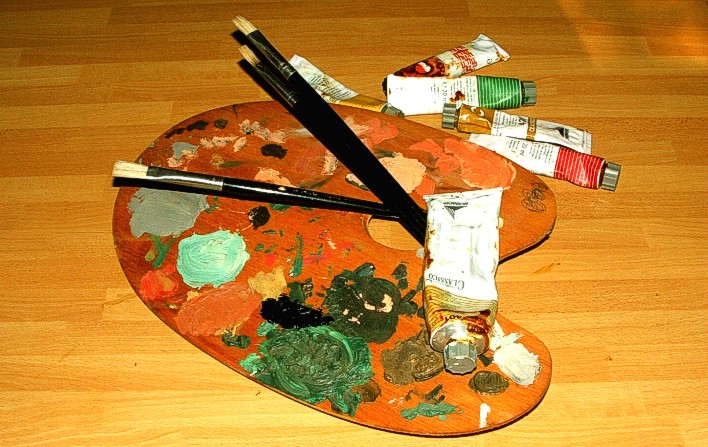
Go ahead and slop some paint on a canvas. So what if you're forty-two and your mom is still asking, "What is it?" You can hang your masterpiece on your own refrigerator. Play that song one-handed on the keyboard. If Grandpa asks you to stop, threaten to put him in a home. (Just kidding, Gramps.)

Knit that lop-sided baby blanket. Spread your craft supplies all over the floor. Play those three chords on the guitar. Make some noise. Make a mess. Make a fool of yourself, dancing along with So You Think You Can Dance. Take a risk. Try something new.

You don't have to know how to do the thing you love to do. A friend who plays improv piano brilliantly once told me, "I don't really know how to play the piano." And I knew just what he meant. 

He doesn't know how. He couldn't draw a diagram of where his fingers should be at any given point in the song. It's a sort of a dance of the fingers across the keys, and there's a bit of a mystery about how it happens. It would be such a strain on the brain to have to pre-plan every note, every harmony, every ornament. Not knowing how is actually more fun.


Finding a creative outlet may or may not make you a great singer, tap-dancer or trapeze artist. But it will make you a happier person. And that will make you better at everything else, like doing your job or raising a family. And you will have a secret identity as an arteest.

Doesn't matter if you aren't good enough or you don't know how or you don't do it right or Aunt Matilda Louise disapproves. 

Do it anyway!


Saturday, August 4, 2012

Squeaky


“There’s a bad egg in every nest.”


That’s what Grandma Beakie always said. And she oughta  know. 


After all, one of her eggs is my Uncle Darwin, and he's always been an odd duck. Cow lick over his left eye. Walks without a waddle.  A duck without a waddle? Need I say more?

“There’s a bad egg in every nest.”

My mom said it too. I used to think she meant me, but that was before my sister Gloriana became a vegetarian and took up the cello. If you ask me, she’s no duck--she’s a turkey. 


So with my family history, maybe you can see how my heart filled with dread when I found myself sitting on a nest, and one egg just a wee bit peculiar. Was it the shape or the color? I wasn't sure, but I had a funny feeling in my gizzard. 


Rodney, my mate, said not to worry. It was just my imagination.  No bad eggs on his side of the family, clear back to Peking Duck. 


Yeah, right.


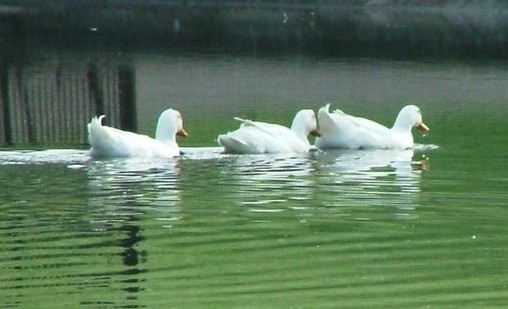
So maybe my family has the occasional odd duck,  but  for many generations, we have taken great pride in being purebreds. White feathers. Orange beaks. Waddle when we walk. Pointy tails that swish. 


Still. . ."there’s a bad egg in every nest." And when the ducklings hatched, Grandma’s words came back to haunt me. 


At first I made excuses, but eventually I had to admit it--one of my duckies was an odd duck.


He didn’t walk like a duck. In fact, he didn’t walk at all.


He didn’t talk like a duck. He spoke only one word: "Squeak." So we called him Squeaky.


He was adorable. He just wasn’t very. . .ducky.


The other ducklings used him for water polo. “Push Squeaky through the hoop. Five points!" And sometimes they liked to sneak up behind their Great Uncle Darwin and squeeze Squeaky really hard. “Sque-e-eak!” 


“Here comes Freaky!” Uncle Darwin would always say. “You're not a real duck. You're a rotten egg.”


What’s a mother to do? Just love my son and try to keep him safe. I thought that would be enough. I hoped that would be enough.


Then one day, out of nowhere, it came. Eyes like flame. Jaws like a bear trap. Miles and miles of teeth. We had heard stories, but we had never seen one in the flesh until his great bulk darkened the light of the sun. 


An alligator!


His eyes flashed. His jaws opened. His fowl breath hung in the air. Then, like the stroke of doom, the jaws snapped and took all my babies. All gone in one bite. All except Squeaky, who never quite got the hang of ducks-in-a-row.


Then Squeaky did a brave thing. Stupid maybe, but brave nonetheless.  Before the beast could swallow, Squeaky swam right up to the gator’s ear and did what he did best. 


“SQUE-E-E-EAK! “


The gator’s eyes popped. His mouth flew open. And in a cloud of fluff, out flew my ducklings. I couldn't believe my eyes.


And then, before I could shout, “Run, Squeaky," my brave little duckie swam right up to the jaws of doom and looked the leviathan in the eye. I watched in horror as the gleaming teeth descended once more and the fearsome jaws devoured Squeaky. 


This time, the gator did swallow. Or at least he tried. But I guess Squeaky stuck in that gator’s throat. The gator coughed and sputtered and gasped. He thrashed about, eyes bugging out of his head, churning the water furiously--until with one final gasp he quit thrashing and sank like a rock.


We stared at the bubbles on the water until the bubbles stopped.


"Squeaky!" I cried, tears running down my beak. 


“Squeaky!” cried all the ducklings.


"Children," I said at last, "we need to make haste. This pond is no longer safe. We have to find a new home.”


"But Mom, what about Squeaky?”


I bowed my head in grief.


I tried to steady my voice. "We’ll always remember how brave he was."


Fluffy spoke up. "We’ll always remember how he made us laugh."


Then Swishtail: "We'll always remember what a good sport he was."


Then Quacker: "We’ll always remember the way he used to. . . ."


“Sque-e-eak!” 


I knew that voice! We all turned and there came Squeaky. He had battled the beast and won! All the ducklings cheered. All the pond creatures squawked, flapped, and croaked. Gloriana played her cello.


We made a nice home in a new pond. Uncle Darwin, of course, came with us. But the next time he made wisecracks about “Freaky,” all the ducklings gathered around him and cried, “Squeak, squeak, squeak.” Then they pecked at him until he begged for mercy.


Squeaky has made us all think about what it really means to be a duck.  Orange beak? Walk with a waddle? Shaking our tail feathers?  It turns out that being a duck is something that’s in your heart, not just your gene pool.    


And as for Uncle Darwin, I guess he can’t help being pond scum. After all, there’s a bad egg in every nest.


For a more dignified version of this classic tale, read "The Ugly Duckling," by Hans Christian Andersen.

But if you like your fairy tales fractured, you might also enjoy. . .